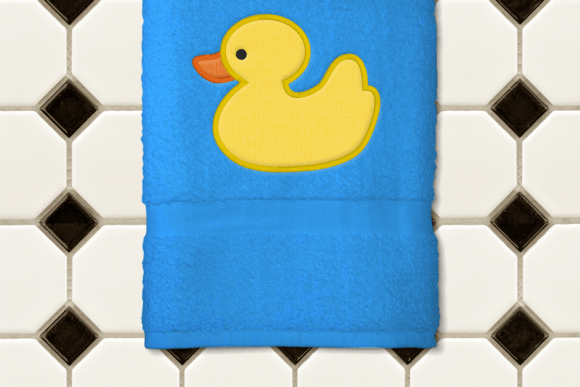
Rubber Duck Applique: A Playful, Practical Patch for Small Business Merch
First Impression: Friendly, Approachable, and Surprisingly Versatile
As an embroidery designer who’s reviewed thousands of digital embroidery files for commercial use, my first impression of Rubber Duck Applique is immediate and positive: it reads as warm, lighthearted, and authentically handmade—without sacrificing clarity or stitch integrity. The title alone signals its intent: this isn’t a cartoonish novelty, but a well-considered machine embroidery design built for real-world application. “Great for towels and babies” hints at softness and safety, but don’t underestimate its broader appeal. In today’s market—where small business merch thrives on personality and approachability—Rubber Duck Applique delivers visual friendliness with quiet professionalism.
Real-World Business Use: From Aprons to Etsy Listings
This design shines where small businesses need memorable, scalable branding: embroidered patches for staff uniforms, chest accents on café aprons, playful sleeve details on boutique tote bags, or even subtle cap embroidery for florists and pet brands. Its clean silhouette and balanced proportions make it highly adaptable across product categories—from Bed-related items like baby towels and nursery linens to custom apparel like bakery smocks or craft studio jackets.
For Etsy sellers and handmade brands, Rubber Duck Applique works beautifully as a signature touch: stitched onto reusable produce bags, sewn into seam labels of organic cotton onesies, or applied as a peel-and-stick patch (with heat-activated backing) on retail packaging. It also performs exceptionally well in printable mockups—its strong outline and moderate detail translate clearly in digital presentations, helping clients visualize the finished product before production begins.
In commercial embroidery settings, I’ve seen Rubber Duck Applique successfully scaled down to 2.5 inches for uniform chest logos and enlarged to 4.5 inches for tote bag centerpieces—all while maintaining legibility and structural cohesion. Its appliqué construction (rather than dense fill-stitch) reduces stitch density, which means faster run times, less thread consumption, and better drape on lightweight fabrics like linen blends or brushed cotton.
Where to Use It Thoughtfully—Not Everywhere
While versatile, Rubber Duck Applique isn’t universally ideal. Avoid placing it on extremely curved surfaces—like the front of low-profile caps—without testing first; the duck’s rounded body may distort if stretched across tight contours. Similarly, when using it as a tiny embroidered patch (under 1.75 inches), verify that key features—like the beak and eye—remain distinct after digitizing adjustments. High stitch density isn’t an issue here (it’s an appliqué), but thread color contrast becomes critical on dark uniforms or textured fabric like terry cloth or heavy canvas. Always test on your actual base material—not just stabilizer-backed muslin.
Also consider context: Rubber Duck Applique reads as cheerful and nurturing, making it perfect for baby boutiques, pediatric clinics, eco-friendly cleaners, or whimsical bakeries—but potentially mismatched for luxury law firms or formal hospitality brands. Its strength lies in reinforcing brand identity through warmth and authenticity, not authority or austerity.
How Rubber Duck Applique Strengthens Brand Identity
Small business merch lives or dies by perceived value and emotional resonance. Rubber Duck Applique elevates handmade product presentation by adding tactile charm without clutter. Customers subconsciously associate its friendly shape with care, playfulness, and attention to detail—traits that build trust, especially in service-based or locally rooted businesses. When repeated across multiple touchpoints—a stitched tag on a ceramic mug, a patch on a staff apron, and a subtle motif on a thank-you card—it creates visual consistency that reinforces recognition and loyalty.
Unlike generic vector icons, this machine embroidery design carries the weight of craft: every curve is digitized for smooth satin stitching, every edge optimized for clean cutaway. That craftsmanship translates directly to perceived professionalism—and higher willingness-to-pay among discerning buyers on Etsy, local markets, and boutique retail channels.
Practical Embroidery Designer Notes for Commercial Use
Before launching Rubber Duck Applique into production, follow these tested steps:
- Test in black and white first—verify contrast and balance without color distraction.
- Check minimum viable size—does it hold up at your smallest intended patch dimension? Resize and re-hoop to confirm.
- Review thread color pairing—yellow duck on navy denim? White duck on charcoal twill? Swatch combinations on your target fabric.
- Inspect spacing and underlay—appliqué designs rely heavily on precise placement and secure tack-down stitches; ensure no floating edges or puckering risk.
- Confirm hoop size compatibility—some versions may require larger hoops for full coverage; cross-check with your machine specs.
- Use appropriate stabilizer—lightweight cutaway for stable wovens, tear-away for towels, and fusible web for iron-on patches.
- Create a physical mockup—not just digital—before client approval. Fabric drape, thread sheen, and scale shift dramatically in real life.
- Compare alongside other design assets—does Rubber Duck Applique harmonize with your existing logo, typography, and color palette?
- Verify commercial licensing—this is essential. Since Rubber Duck Applique is marketed as a machine embroidery design for multiple machines, confirm it permits resale of finished products and use in small business merch.
Final Thought: More Than a Duck—It’s a Branding Tool
Rubber Duck Applique isn’t just another embroidery file. It’s a strategic asset—compact, expressive, and engineered for real business impact. Whether you’re stitching for a neighborhood florist, launching a line of organic baby goods, or building cohesive merch for a creative studio, this design bridges function and feeling. It reminds customers that behind every product is a human touch—and sometimes, that touch looks like a cheerful, well-digitized rubber duck.