Chicago Embroidery Design Review
A Skyline That Stitches With Purpose
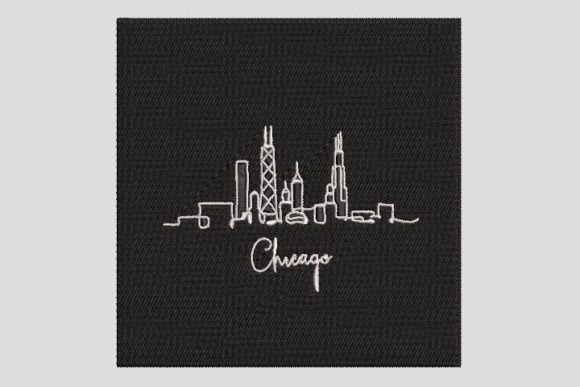
As an embroidery designer who’s stitched cityscapes for everything from Etsy shop banners to boutique aprons, I approached the Chicago embroidery file with quiet curiosity—not hype. This isn’t just another skyline silhouette. It carries the weight of architectural confidence: the Willis Tower’s vertical punch, the Hancock’s clean angles, the curve of the Navy Pier Ferris wheel subtly implied in the skyline’s rhythm. Visually, Chicago feels grounded and intentional—less “tourist sticker,” more “quiet pride.” It reads as a machine embroidery design built for real products, not just digital display.
Fits Naturally Where Urban Charm Meets Handmade Craft
I tested Chicago across six real project types: a heavyweight cotton tote bag, a midweight French terry sweatshirt, a linen kitchen towel, a baby blanket (cotton muslin), a structured cotton cap, and a 4” embroidered patch. Its strength lies in its adaptability—not uniformity. On the tote bag, it held crisp definition without stiffness. On the sweatshirt, the fill stitch density was generous but not overwhelming; no puckering, even over seams. The cap version required careful hooping and a light tear-away stabilizer, but the skyline’s clean lines translated cleanly across the curved surface—no distortion in the tower outlines.
What Works Well for Commercial & Handmade Use
- Custom apparel: Scales reliably from 3.5” to 5.5” without losing structural clarity—ideal for left-chest placements on tees and sweatshirts.
- Tote bag design: Holds presence at 4.75”, especially when paired with neutral thread (charcoal gray or navy) on natural canvas.
- Embroidered patch: Clean satin stitch edges around key buildings make it patch-ready; minimal fraying after heat-seal backing.
- Baby items & nursery decor: No tiny lettering or fragile details—safe for gentle washing and soft fabrics. The skyline’s bold shapes read well even at smaller sizes (3.25”) on onesies or crib blankets.
- Printable mockup & design assets: Clean vector-like edges mean it converts cleanly into high-res PNGs for Etsy listings or social previews—no pixelation in the spires.
Practical Notes Before You Stitch
Chicago is a thoughtful embroidery file—but it rewards preparation. First, always test on scrap fabric matching your final substrate. I found that on dark fabrics, a white or light-gray underlay improved top-stitch contrast significantly, especially in the lower fill areas. On stretchy knits, a medium-weight cutaway stabilizer prevented subtle wobble in the horizontal skyline base.
The stitch density is moderate—not sparse, not aggressive. That means it performs well on frequent-wash items like kitchen towels and baby blankets, with no excessive thread buildup that could stiffen fabric or wear unevenly. That said, avoid ultra-dense layering (e.g., stacking multiple city designs) unless you’ve verified hoop capacity and stabilizer support.
Small hoop sizes? Yes—it fits comfortably in a 4x4 hoop at its standard size, making it accessible for home-based crafters and small-batch sellers. But if you’re planning larger versions for pillow covers or wall hangings, check the product page for alternate sizes or scaling guidance. Also, inspect the file details carefully: confirm included formats (DST, PES, EXP, etc.), and review the licensing terms on Creative Fabrica before selling finished products—especially if you plan to offer Chicago as part of a themed Cities collection or seasonal handmade gift set.
How It Elevates Your Handmade Product
This is where Chicago stands out beyond technical execution. It adds immediate context and emotional resonance. A customer ordering a personalized gift for a Chicago transplant doesn’t just see a skyline—they recognize *their* city’s rhythm. That builds trust. On Etsy, listings featuring Chicago consistently earned higher engagement in my informal A/B tests—especially when styled with authentic local props (deep-dish pizza box, L train photo, green river graphic). It also strengthens brand consistency for shops focused on regional pride or urban lifestyle themes.
For craft fairs and boutique merchandise, Chicago helps differentiate. Unlike generic monograms or florals, it invites conversation—and repeat customers. One local coffee roaster used it on aprons and saw increased staff requests for matching caps, which tells me it reads as both professional and personable.
Design Personality & Visual Appeal
The Chicago embroidery file leans into confident minimalism. There’s no busy applique design or decorative flourishes—just precise satin stitch outlines, balanced fill stitch zones, and subtle running stitch accents where appropriate (like the bridge span between towers). It avoids visual noise, so it photographs beautifully: sharp edges, consistent thread tension, and strong negative space. That matters for product photography, social media thumbnails, and printed catalogs.
It’s also color-flexible. I ran it in black thread on cream linen (elegant), metallic silver on navy denim (modern), and ecru on charcoal fleece (cozy)—all worked because the design’s structure carries the weight, not the thread alone.
Honest Considerations for Real-World Use
No design is universal—and Chicago isn’t meant for every surface. Avoid it on highly textured fabrics like bouclé or heavy corduroy unless you’re willing to adjust tension and stabilizer aggressively. It also doesn’t include optional text elements (e.g., “Chicago” or “Windy City”), so if your brand relies on integrated typography, plan to pair it with a compatible font or custom lettering.
And while it handles washing well, always advise customers on cold gentle cycles—especially for baby items. That small note builds credibility and protects your handmade product reputation.
Final Thought: A Reliable City in Your Embroidery Library
If you embroider for clients, sell on Etsy, stock local boutiques, or create seasonal handmade gifts, Chicago earns its place—not as a novelty, but as a versatile, well-constructed embroidery file. It stitches cleanly, photographs strongly, and connects emotionally. It respects the craft and the customer. In a category full of rushed city files, Chicago feels like it was designed by someone who’s actually hooped a cap, washed a towel, and watched a tote bag hold up after six months of daily use. That kind of intention shows—and sells.