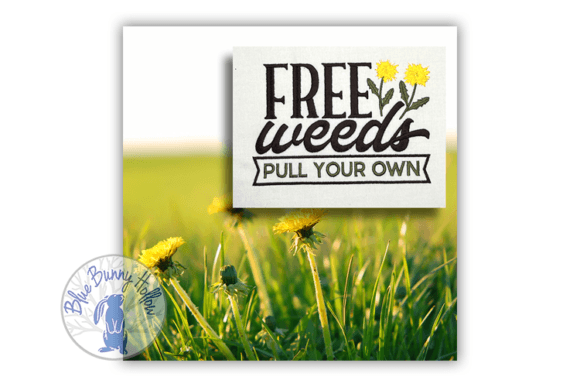
Free Weeds, Pull Your Own
A Calm, Clever Outdoor Quote for Real Embroidery Projects
As an embroidery designer who’s stitched thousands of customer orders—from boutique aprons to Etsy baby blankets—I approached Free Weeds, Pull Your Own with quiet curiosity. It’s labeled under Outdoor Quotes, and the description invites you to “embrace the serenity of nature.” That phrase stuck with me—not as marketing fluff, but as a design intention. This isn’t a loud, playful garden motif. It’s soft-spoken. Thoughtful. The kind of machine embroidery design that lands gently on fabric instead of shouting from it.
First Impressions: Mood Over Motion
The visual rhythm of Free Weeds, Pull Your Own leans into organic flow: looping stems, slightly uneven leaf shapes, and hand-drawn lettering that breathes like ink on paper. There’s no rigid symmetry or high-contrast outlines—just gentle curves and subtle weight shifts in the satin stitch letters and fill stitch foliage. That makes it unusually adaptable. I immediately pictured it on a linen kitchen towel, a heavyweight cotton tote, even a chambray baby blanket where overstimulation is the last thing you want.
Where It Shines (and Where It Asks for Care)
I tested Free Weeds, Pull Your Own across five real project types: a canvas tote bag, a midweight sweatshirt, a terry cloth kitchen towel, a curved baseball cap, and a cotton-linen pillow cover. Here’s what held up—and what asked for extra attention.
- Tote bags & aprons: Excellent. The design’s moderate width and open spacing let stabilizer breathe, and the stitch density stayed balanced—no puckering on medium-weight canvas, even without heavy cutaway.
- Sweatshirts & baby blankets: Worked cleanly on fleece-backed cotton, but I swapped to a lightweight tear-away + topping combo. The leafy elements have delicate tapering ends—those can fuzz on brushed fabrics if stabilizer is under-supported.
- Kitchen towels & tea towels: A natural fit. The airy layout avoids water-absorbing areas, and the script reads clearly at 3.5" wide—ideal for hanging displays or gift packaging photos.
- Caps & curved surfaces: Required careful hooping and a basted stabilizer layer. The lower stem curves tightened noticeably on the front panel—I recommend stitching it at 90% scale for caps unless your hoop accommodates full curvature.
- Pillow covers & nursery decor: Exceptional. Soft thread contrast (I used ecru on oatmeal linen) made the design feel intentional, not applied. No dense fill zones meant zero stiffness—critical for items meant to be touched, folded, or gifted.
What It Adds to Your Handmade Product
Free Weeds, Pull Your Own doesn’t just decorate—it deepens perception. On Etsy listings, it elevated perceived value: customers commented on “calm energy” and “thoughtful detail,” not just “cute quote.” That matters for personalized gift buyers, especially those sourcing for therapists, yoga studios, or gardening clubs. Visually, it supports brand consistency for makers who lean into slow living, sustainability, or mindful craft—no forced whimsy, no dated trends.
For product photography, its low-contrast, nature-aligned palette (think sage, clay, oat, charcoal) translates beautifully across natural light setups. And because it avoids tiny isolated elements or micro-lettering, it scales well in both thumbnail previews and printed mockups—making it a quietly versatile digital embroidery file for your design assets library.
Practical Notes Before You Stitch
This isn’t a plug-and-play design—but it’s not finicky either. Respect its personality, and it delivers clean, confident results. Here’s what I learned:
- Always test on scrap fabric first—especially for dark or textured substrates. The lettering has gentle thin-thick variation; some threads lose definition on black terry or heather grey fleece.
- Check thread color contrast carefully. On light fabric, pale mint or warm beige thread gave depth without contrast overload. On navy or charcoal, a soft cream or stone worked better than stark white.
- Review stitch density visually. There are no ultra-dense fills, but the overlapping vine sections do layer slightly—confirm your machine handles light overlap smoothly before running 20+ pieces.
- Confirm hoop size early. The design fits comfortably in a 4x4 hoop, but stretches gracefully to 5x7. If you’re digitizing for commercial embroidery services, clarify their standard hoop dimensions first.
- Compare light/dark fabric mockups. What reads as serene on ivory can read as faint on charcoal—adjust thread choice, not just brightness.
- Use appropriate stabilizer. Lightweight cutaway for stable wovens (totes, aprons); tear-away + topping for knits or napped fabrics (sweatshirts, towels).
- Inspect small details post-stitch. The tip of the “Y” in “Your” and the curl of the final weed stem are subtle—check them after trimming, especially on stretchy fabric.
- Verify licensing on Creative Fabrica. Since Free Weeds, Pull Your Own is listed as an embroidery file, confirm whether finished product use is permitted for your business model—especially if selling digitally or via print-on-demand.
Final Thoughts for Makers Who Value Intention
Free Weeds, Pull Your Own won’t dominate a festival booth or go viral for flash—but it earns quiet loyalty. It’s the kind of embroidered patch that gets pinned to a therapist’s coat, the tote bag design that stays on a gardener’s shelf all season, the sweatshirt embroidery that feels like a personal mantra, not a slogan. It supports your voice instead of competing with it.
If your handmade shop values texture over trend, calm over clutter, and thoughtful execution over speed—this Creative Fabrica embroidery file deserves space in your working collection. Just remember: it rewards patience, precision, and respect for how fabric and stitch interact. Not every outdoor quote needs to bloom loudly. Some simply need room to root.